
You must be logged in to post a comment.
Our last
News
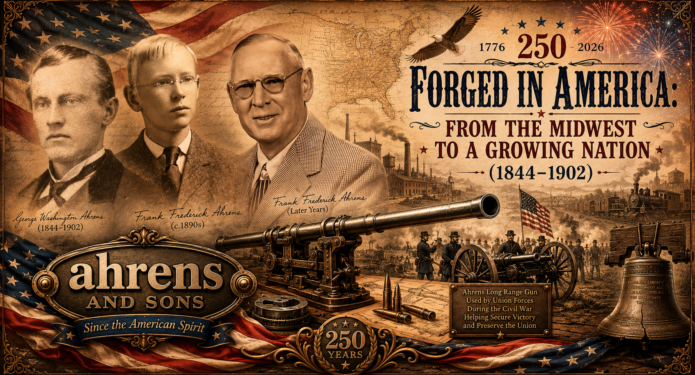
Forged in America: The Ahrens Legacy
Part I — Forged in Freedom From the Midwest to a Growing Nation (1844–1902)
A Three-Part Series Celebrating America’s 250th Anniversary
Editor’s Note
As America commemorates its 250th Anniversary in 2026, Ahrens Companies is honored to share the story of one family’s journey through more than 180 years of American history. Spanning six generations, this three-part series explores how the Ahrens family’s tradition of craftsmanship, innovation, and service evolved alongside the growth of our nation—from a family of skilled metalworkers in America’s heartland to one of Florida’s longest-standing construction legacies.
This first installment traces the family’s earliest roots in America, their contribution to a nation in transition, and the journey that ultimately brought generations of metalworking craftsmanship to the emerging communities of South Florida around the turn of the twentieth century.
Forged in Freedom
Long before skylines were filled with steel, before cranes stretched across the horizon, and before South Florida became one of America’s fastest-growing regions, the story of the Ahrens family was already unfolding. Like the story of America itself, it is a story of opportunity, perseverance, craftsmanship, and the belief that each generation has a responsibility to build something stronger than the one before it. The Ahrens family’s American story begins in 1844, only sixty-eight years after the signing of the Declaration of Independence. The United States was still a young nation, expanding westward and rapidly transforming from an agricultural society into an industrial power.
Among the many immigrant families seeking opportunity was the Ahrens family, whose knowledge of metalworking would become the foundation of a legacy that has now spanned more than half of America’s history. Their destination was St. Louis, Missouri—the “Gateway to the West.” Positioned along the Mississippi River, St. Louis was one of the nation’s fastest-growing cities and an emerging center of manufacturing, transportation, and industry. It was a place where blacksmiths, machinists, foundries, and craftsmen helped build everything from railroads and riverboats to tools, machinery, and the infrastructure of a rapidly expanding nation. For the Ahrens family, metalworking was more than a profession. It was a calling. Within their workshop, iron and steel were transformed into practical tools, architectural components, machinery, and precision-crafted products. Each generation inherited not only the trade itself but also a philosophy—that quality workmanship, integrity, and innovation were inseparable from lasting success. Those values would become the defining characteristics of the Ahrens name.
A Family Supporting a Nation
As the United States entered its greatest internal conflict, the Ahrens family’s skills would become part of something much larger than themselves. When the Civil War began in 1861, Missouri occupied a uniquely important position. Although officially remaining within the Union, it was a deeply divided border state whose location made it one of the most significant manufacturing and logistical centers in the Western Theater.
Just miles from the family’s workshop stood the St. Louis Arsenal, one of the Union Army’s largest military supply depots. As wartime production accelerated, the Arsenal depended upon an extensive network of independent foundries, blacksmiths, machinists, and family-owned metalworking shops throughout the region to help meet unprecedented demand.
Historical records from Missouri document local craftsmen producing forged iron products, wagon hardware, cavalry equipment, camp tools, precision-machined components, and countless other materials that supported the Union war effort. Among the most recognizable firearms carried by Union soldiers was the Springfield Model 1861 Rifled Musket, the standard infantry weapon used throughout much of the Civil War. While surviving federal procurement records do not identify the Ahrens family as prime contractors for complete rifles, family history and regional manufacturing records place their metalworking business among the community of skilled craftsmen whose work supported Union production.
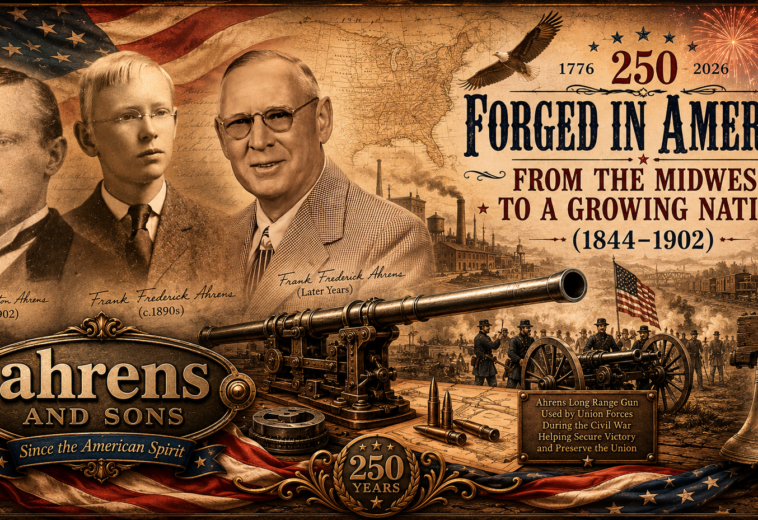
According to preserved family history, members of the Ahrens family also contributed to improvements in a long-range firearm used during the Civil War. Today, the family continues to preserve a commemorative plaque recognizing that contribution to the Union cause—a tangible reminder of a time when craftsmanship served not only industry, but the preservation of the nation itself.
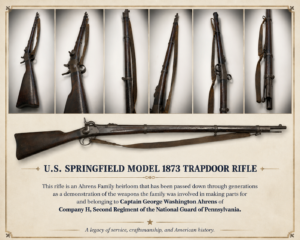
The family’s contribution represented far more than technical expertise. It reflected principles of service, integrity, perseverance, and equality that would continue to influence future generations and ultimately become part of the culture that shaped the Ahrens legacy.
Captain George Washington Ahrens

(Young George Washington Ahrens)

(Commission of Captain Certificate)

(Photos dated ≈1883)
Into this world of craftsmanship and public service, George Washington Ahrens was born in St. Louis in 1853. Census records show he was raised alongside four siblings during an era when America was rebuilding itself following the Civil War and entering one of the most remarkable periods of industrial growth in its history.
For George, the workshop became a classroom.
There he learned not only how to shape metal, but also how to solve problems, value precision, and understand that a craftsman’s reputation was earned one project at a time. As the nation matured, so did George.
Historical family records include official commissions issued by the Commonwealth of Pennsylvania appointing George Washington Ahrens as Captain of Company A, Second Regiment Infantry, First Brigade of the Pennsylvania National Guard. Signed by Governors James A. Beaver and Robert E. Pattison, the commissions recognized his leadership and entrusted him with serving as an officer within one of Pennsylvania’s principal military organizations.
The title “Captain George Washington Ahrens” reflected more than rank.
It represented a lifetime dedicated to leadership, discipline, responsibility, and service—qualities that would later define his approach to both family and business.
Around 1887, George married Alice M. Stone of New Jersey. Together they welcomed their son, Frank Frederick Ahrens, beginning the next generation of a family tradition rooted in craftsmanship.
Census records trace the family’s journey through Missouri and New Jersey during a period when America’s industries, cities, and railroads were expanding at an extraordinary pace. Opportunity was moving. So was America.
Looking South
By the closing years of the nineteenth century, another visionary was transforming the future of an entirely different part of the country. Industrialist Henry Flagler had begun extending the Florida East Coast Railway, opening Florida’s Atlantic coast to unprecedented growth and investment. What had once been isolated settlements were becoming thriving communities almost overnight. Palm Beach and West Palm Beach attracted architects, entrepreneurs, craftsmen, and builders eager to participate in one of the nation’s newest frontiers. For George Washington Ahrens, whose family had spent generations mastering the craft of metalworking, the opportunity was unmistakable.
Around 1902, he brought his family’s generations of metalworking experience to South Florida, beginning what would become more than a century of continuous service to the region. As Palm Beach and West Palm Beach entered an extraordinary era of growth, the Ahrens family began applying their craftsmanship to the communities taking shape along Florida’s east coast. The family’s work in Florida was built upon generations of accumulated knowledge—skills forged in the workshops of St. Louis and refined through decades of American industrial progress. What began as a continuation of a family trade would, over time, evolve into multiple businesses serving South Florida’s growing construction industry while remaining rooted in the craftsmanship that had defined the Ahrens family since the nineteenth century.
Neither George nor his young son Frank could have imagined how their family’s work would become woven into the history of South Florida. What began as one family’s pursuit of opportunity was about to become something much larger.
The next chapter would see generations of the Ahrens family help shape the architectural identity of Palm Beach County through craftsmanship, innovation, and an unwavering commitment to quality—leaving a legacy that continues to endure more than a century later.
Explore the following chapters:
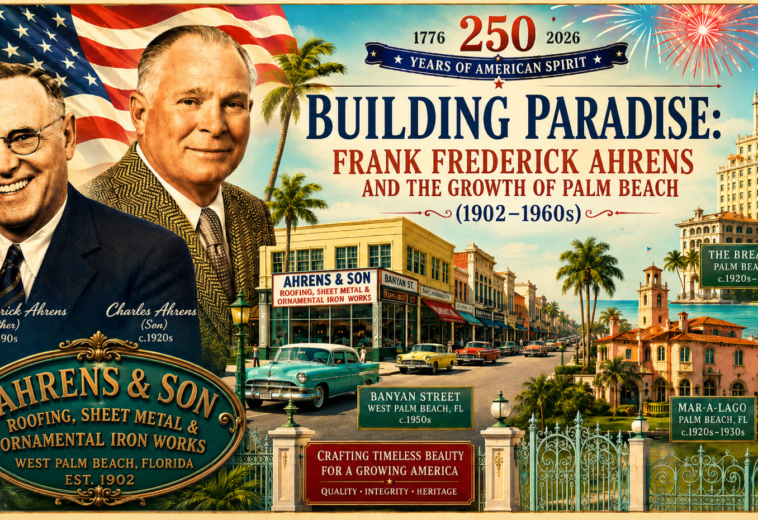
Part 2: Iron and Opportunity — Building Paradise (1902–1960s)
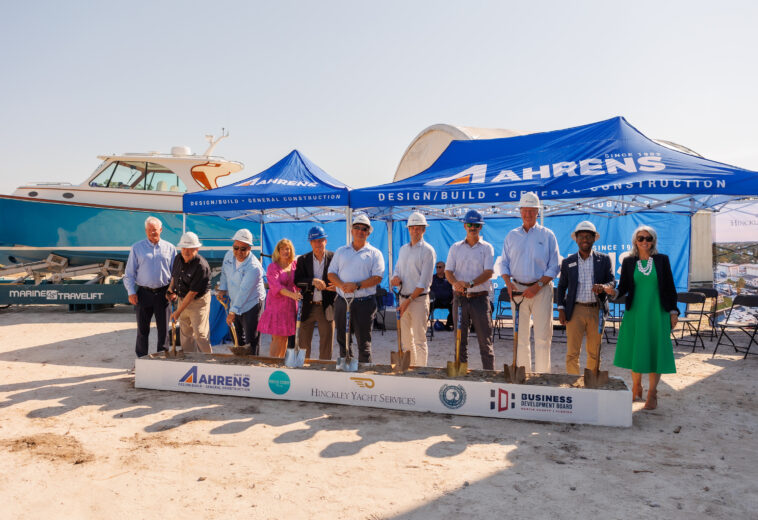
Part 3: Building on a Legacy — Evolution of a Family Business (1960s–Today)
01.
Leave a Reply