
You must be logged in to post a comment.
Our last
News
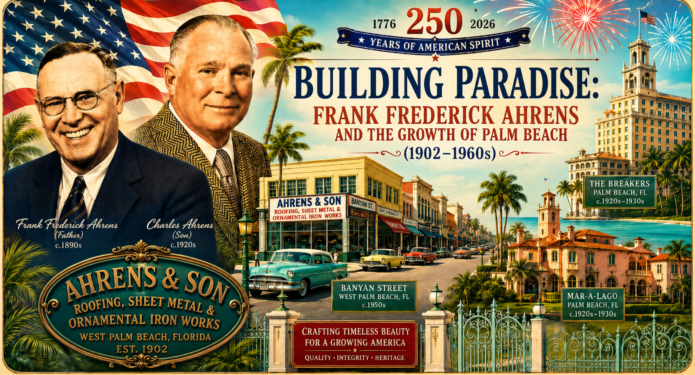
Forged in America
The Ahrens Legacy
Part II — Forging Palm Beach (1902–1960s)
A Three-Part Series Celebrating America’s 250th Anniversary
Editor’s Note
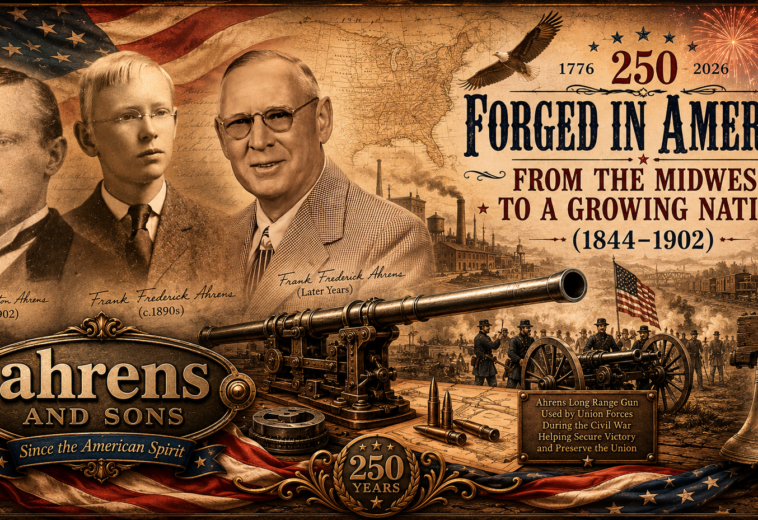
As America celebrates its 250th Anniversary, we continue our journey through the history of the Ahrens family—a story that has unfolded alongside the growth of our nation for more than 180 years.
In Part I, we explored the family’s roots in St. Louis, Missouri, their tradition of metalworking, and the journey that brought George Washington Ahrens and his family to South Florida around the turn of the twentieth century.
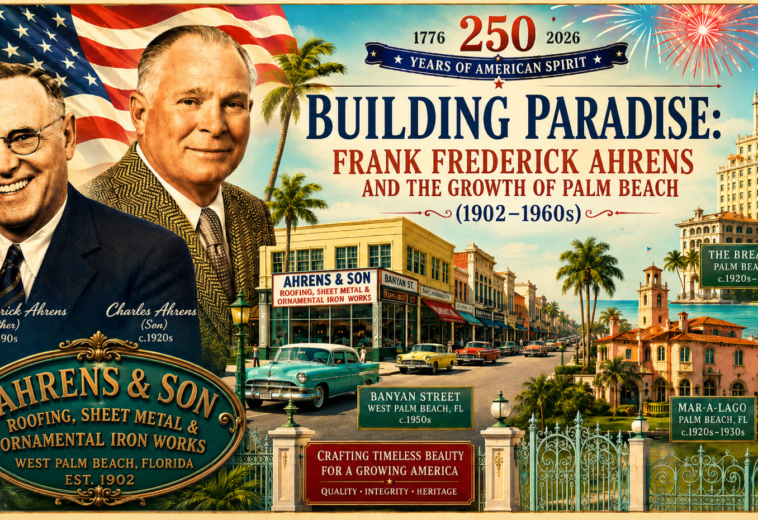
Now, in Part II, we follow George and his son, Frank Ahrens, as they help build a young West Palm Beach, transform a family trade into a thriving enterprise, and develop innovations that would leave a lasting mark on the American construction industry.
Building a New Frontier
At the dawn of the twentieth century, West Palm Beach was still a frontier community.
Henry Flagler’s Florida East Coast Railway had unlocked an entirely new chapter in Florida’s history, bringing visitors, commerce, and unprecedented development to the region. Grand hotels rose along the coast. Magnificent private estates began taking shape on Palm Beach Island. Businesses, churches, schools, and civic buildings followed, each requiring skilled craftsmen capable of turning ambitious architectural visions into reality.
Among those arriving to seize that opportunity was George Washington Ahrens and his son, Frank Frederick Ahrens
Frank had become fascinated by the possibilities unfolding in South Florida while working alongside his father in Camden, New Jersey. Inspired by Flagler’s vision, he purchased a one-way train ticket on the Florida East Coast Railway to its southern terminus in West Palm Beach. Arriving with little more than determination and ten dollars in his pocket, Frank initially found work as a plumber while learning the needs of the rapidly growing community.
Soon afterward, George joined his son in Florida.
Recognizing the tremendous opportunity before them, George purchased two parcels of land along Okeechobee Road. After selling those properties at a profit only months later, the proceeds provided the capital that allowed father and son to begin what would become one of South Florida’s most enduring family business legacies.
Rather than arriving with wealth or established connections, the Ahrens family arrived with something far more valuable—generations of experience working with metal and an unwavering belief that craftsmanship would always find opportunity.
The Only Sheet Metal Company in South Florida
Around 1902, George and Frank began offering roofing, sheet metal, and ornamental ironwork to a region that was growing almost faster than it could build.Historical accounts describe Ahrens & Son Roofing, Sheet Metal & Ornamental Iron Works as the only roofing and sheet metal company serving South Florida during those earliest years.Their first workshop occupied a modest location behind the Palm Beach Mercantile Company on Clematis Street, where they operated from 1902 through 1905.
 |
| Photo sourced from The Palm Beach Post |
 |
| Photo sourced from The Palm Beach Post |
Business came quickly.
As Palm Beach’s great estates and commercial buildings rose from the sand, the demand for skilled sheet metal fabrication and ornamental ironwork increased dramatically.
The family became known not only for roofing and architectural sheet metal, but also for the custom fabrication of decorative wrought iron—including elegant chandeliers, ornamental railings, gates, and architectural details that became hallmarks of Palm Beach’s Mediterranean Revival architecture.
Their craftsmanship soon found its way into many of the region’s most distinguished properties, including the Whitehall Estate, the Post Estate (Mar-a-Lago), the Biltmore Hotel, the Paramount Theatre, the Harvey Building, and the private estates of families including Hutton, Stotesbury, Chase, and Dodge.
As Palm Beach grew, so too did the reputation of the Ahrens family.
Growing with West Palm Beach
The story of the Ahrens family mirrors the story of downtown West Palm Beach itself.
As business expanded, so did the company.
In 1906, the family relocated to the Arcade Building on First Street, placing their workshop at the center of a city that was rapidly becoming South Florida’s commercial hub.
Only four years later, continued growth required even larger quarters.
In 1910, George and Frank constructed a new facility directly across the street, where the business remained until 1924. Their steady expansion reflected not only the family’s growing reputation but also the remarkable pace at which West Palm Beach itself was developing.
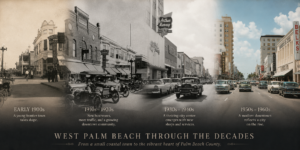
By the mid-1920s, demand had once again outgrown their facilities.
The family relocated operations to 911 South Dixie Highway, establishing what would become one of the region’s best-known industrial properties. At the time, Banyan Street, Clematis Street, First Street, and South Dixie Highway formed the commercial backbone of the young city. The Ahrens operation became one of the earliest and most recognizable industrial businesses in what is now the heart of downtown West Palm Beach.
Over the coming decades, the facility expanded into a bustling manufacturing operation that employed hundreds of skilled craftsmen, machinists, welders, fabricators, and construction professionals. Historical accounts credit the company as one of the area’s largest employers, with more than 300 employees helping supply the region’s rapidly growing construction industry.
As West Palm Beach matured from a frontier town into a thriving city, the Ahrens family grew alongside it.
From One Business to Three
By the late 1920s, it had become clear that the family’s work had expanded far beyond traditional roofing and sheet metal fabrication.
In 1929, Frank Ahrens reorganized the business, creating two new companies that reflected the changing needs of the construction industry.
The Roofing & Sheet Metal Supply Company—later renamed Ahrens Materials in 1947—became one of South Florida’s premier suppliers of roofing products, galvanized sheet metal, insulation, structural steel, fasteners, angle iron, and countless other construction materials.
At the same time, Service Iron Works focused on structural steel fabrication, ornamental iron, custom metal manufacturing, bar joists, pumps, and industrial fabrication.
The diversification represented more than business growth.
It reflected Frank’s belief that innovation and specialization would better serve Florida’s rapidly evolving construction market.
Service Iron Works soon became recognized as the first company in Florida to own a “wiggle bender,” a revolutionary machine used in the manufacturing of steel bar joists. It was another example of the family’s willingness to invest in new technology decades before it became common practice.
The Invention That Changed Construction
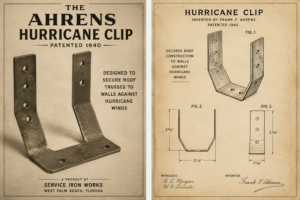
If one innovation defines the Ahrens family’s contribution to modern construction, it is undoubtedly the Hurricane Clip.
In 1940, Frank Ahrens and an associate invented and patented what is widely recognized as the first structural hurricane clip.
At the time, the invention represented a significant advancement in structural engineering.
The heavy-duty metal connector securely fastened wooden roof trusses to wood or masonry walls, dramatically improving a building’s resistance to high winds—a challenge familiar to every Floridian.
Only a year later, however, history gave the invention an even greater purpose.
Following America’s entry into World War II, the United States military embarked on one of the largest construction efforts in its history. Hundreds of thousands of Quonset huts were erected around the world to house troops, store equipment, serve as hospitals, and support military operations in every theater of the war.
According to historical company records, Frank Ahrens’ newly patented hurricane clips were purchased by the truckload and shipped overseas, where they became an essential component in rapidly anchoring Quonset huts against powerful tropical winds and harsh weather conditions.
An invention born from solving Florida’s hurricane challenges had become part of America’s wartime infrastructure.
It remains one of the family’s most significant contributions to the construction industry.
Frank’s inventive spirit continued after the war.
In 1946, he helped develop and patent the B&A Masonry Drill, recognized as the world’s first carbon-tipped masonry drill, another innovation that improved efficiency and durability for builders throughout the construction industry.
Building More Than Buildings
By the late 1940s, the Ahrens name had become synonymous with quality craftsmanship throughout South Florida.
The family’s businesses supplied materials, fabricated steel, designed ornamental iron, manufactured structural components, and supported countless construction projects that shaped the region’s architectural identity.
Yet perhaps their greatest achievement was not any single building or invention.
It was their ability to grow alongside the community they served.
As West Palm Beach transformed from a railroad outpost into one of Florida’s most vibrant cities, the Ahrens family remained deeply woven into its story—adapting, innovating, and continuing to build for each new generation.
The next chapter of that story would see another generation step forward.
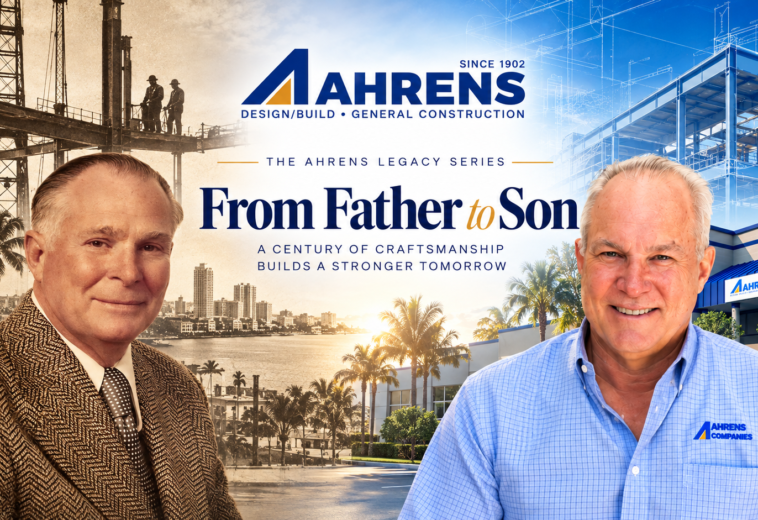
As post-war America entered an era of unprecedented commercial expansion, Charles Ahrens would begin preparing the family business for a new future—one that would ultimately lead to a transformation from metalworking into modern design-build construction.
Explore the other chapters:
Part 1: The Origins of an American Building Legacy (1844–1902)
Part 3: Building on a Legacy — Evolution of a Family Business (1960s–Today)
01.
Leave a Reply